Preparing for an AS9100D audit should not require a scramble.
For most aerospace manufacturers, it does. Documentation gets pulled together in the weeks before a surveillance audit. Records are reconstructed. Compliance evidence is assembled from disconnected systems. The organization passes — and then returns to operating the same way it always has, until the next audit cycle begins.
This is compliance as an event. It is expensive, stressful, and does nothing to improve the operation between audits.
There is a better way.
Compliance Built Into How You Operate
AS9100D requires manufacturers to demonstrate control across every major dimension of their quality management system — from process documentation and competence verification to nonconformance management, corrective action, and continual improvement. Twenty-four clauses across seven major sections, each requiring objective evidence that the system is working.
The Optegrity suite was not built as a compliance tool. It was built to run lean manufacturing operations. But because it captures data, enforces standards, and closes corrective actions at the point where work happens — it produces the objective evidence AS9100D requires as a byproduct of daily operations.
No pre-audit assembly required. The records are already there.
What Each Module Covers
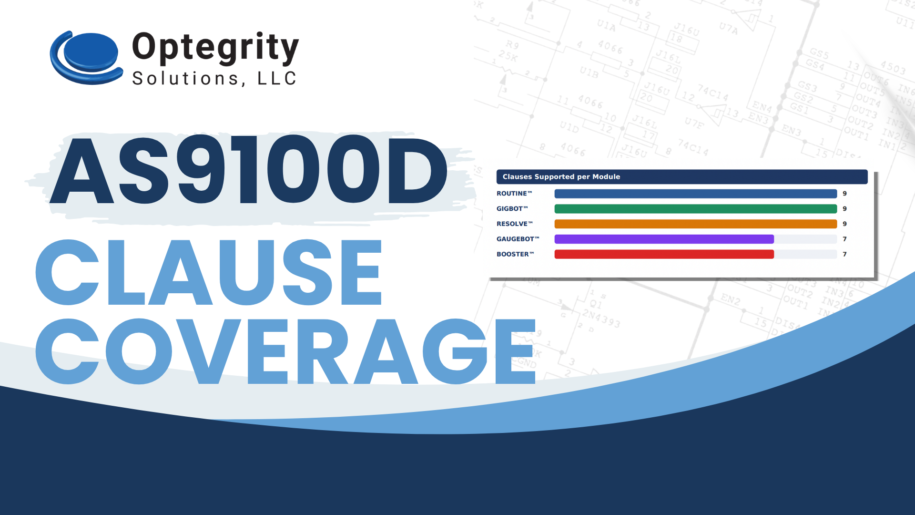
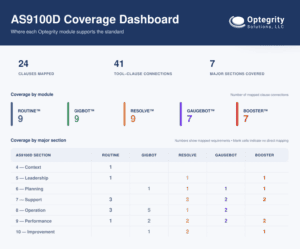
Routine supports nine AS9100D clauses — centralizing SOPs, work instructions, and process documentation with version control, role-based workflow automation, and operator-level traceability across every job and step. Clause 7.5 documented information requirements, Clause 8.5.1 production control, and Clause 8.5.2 identification and traceability are all addressed through the way Routine runs the floor every shift.
Gigbot covers nine clauses — from in-process quality checks and nonconforming output control to supplier quality tracking and customer protection measures. Real-time defect capture means Clause 8.7 nonconformity records exist at the moment they occur, not reconstructed after the fact.
Resolve addresses nine clauses — including Clause 10.2 corrective action, Clause 6.3 change management, and Clause 10.3 continual improvement. AI-guided root cause analysis and structured corrective action workflows close the loop from nonconformity to validated correction with a documented audit trail.
Gaugebot covers seven clauses — with NIST-compliant calibration tracking directly addressing Clause 7.1.5 measurement traceability, and TPM-based asset management supporting Clause 7.1.3 infrastructure requirements.
Booster covers seven clauses — including Clause 7.2 competence, Clause 5.1.1 leadership commitment, and Clause 9.3 management review, through OpEx program management, skill certification tracking, and financial impact reporting that gives leadership the data a QMS review requires.
24 Clauses. 41 Tool-Clause Connections. 5 Integrated Modules.
Across the full suite, Optegrity maps to every major section of AS9100D — Clauses 4 through 10 — with 41 distinct tool-clause connections across 24 mapped requirements.
That coverage is not accidental. It is the result of building software around the operational disciplines AS9100D was designed to enforce: documented processes, verified competence, controlled nonconformances, measured improvement, and management visibility into all of it.
Audit-Ready Is Not a Mode. It Is How You Operate.
The manufacturers who pass AS9100D audits with confidence are not the ones who prepare the hardest in the weeks before the auditor arrives. They are the ones whose systems produce compliance evidence continuously — because the way they run their operation and the way they demonstrate QMS control are the same thing.
Optegrity makes that possible. Schedule a Demo →
Frequently Asked Questions
Does Optegrity certify manufacturers to AS9100D?
No. AS9100D certification is granted by an accredited registrar based on an organization’s full implementation of its quality management system. Optegrity’s suite supports, documents, and provides objective evidence for AS9100D requirements — but certification itself requires a third-party audit and registration process.
Which AS9100D clauses does Optegrity support?
The Optegrity suite maps to 24 AS9100D clauses across all seven major sections — Clauses 4 through 10. Each module addresses specific requirements: Routine covers document control and production execution, Gigbot covers quality and nonconformance, Resolve covers corrective action and change management, Gaugebot covers calibration and infrastructure, and Booster covers competence, leadership commitment, and continual improvement.
How does Optegrity help with audit preparation?
Because Optegrity captures compliance evidence continuously — through work instruction records, quality checks, corrective action trails, calibration logs, and competence documentation — the records required for an AS9100D audit exist as a byproduct of daily operations. There is no pre-audit assembly scramble because the documentation never stopped being maintained.
Is Optegrity relevant for ISO 9001 as well as AS9100D?
Yes. AS9100D incorporates all ISO 9001:2015 requirements and adds aerospace-specific requirements on top. Routine’s document control system is built to be compliant with ISO 9001, AS9100, and ISO 14001. The coverage that supports AS9100D audit readiness also supports ISO 9001 compliance.
Leave a Reply