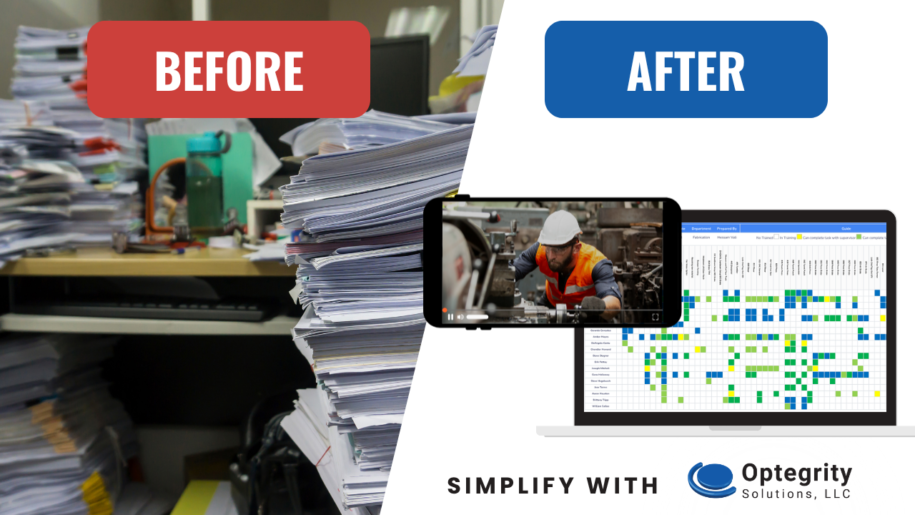
It has a spine label, a table of contents, and laminated pages someone updated eighteen months ago. Every ISO auditor who walks through gives it a nod. It exists. It is compliant.
It is almost certainly not being used.
This is the quiet paradox at the center of most standard work programs: the documentation is there, but the discipline is not. And without the discipline, the documentation is theater.
The Gap Between Documentation and Execution
When a new operator starts on a line, they are typically given an orientation and shown the binder. They may read it — or they may watch the person next to them and do the same.
Within a few shifts, they have internalized a version of the process that may or may not match what is written down.
This is not a failure of the operator. It is a failure of the system.
Documentation that is not accessible at the point of use — in the moment the operator needs it — will always lose to the faster path: watching, asking, and improvising.
How Variation Hides in Plain Sight
One of the most insidious aspects of SOP failure is that variation often does not look like variation.
The line is running. Parts are shipping. Numbers are close enough. The divergence from standard is invisible until something goes wrong. Then it is very difficult to trace which deviation caused the problem.
Lean manufacturing is clear on this: standardized work is the foundation of continuous improvement. You cannot improve a process that is not stable. You cannot stabilize a process that is not documented. And you cannot enforce documentation that lives in a binder nobody reads.
Five Warning Signs Your Standard Work Is Not Working
If any of the following are true in your operation, your standard work program is at risk.
Different shifts run the same process differently — and nobody is tracking the variation.
Your SOP update process takes weeks — and publishing changes to all locations takes even longer.
Operators consult colleagues instead of documentation when they have a question.
New hires are considered fully trained after an informal walkthrough.
Your last ISO audit passed on documentation that nobody on the floor had read.
Any one of these signals is a gap. All five together is a system that has the appearance of standardization without any of the substance.
How to Make Standard Work Actually Work
The fix is not more documentation. It is documentation that is connected to the work itself.
That means procedures accessible at the station — not in a binder across the floor. It means updates that publish instantly to every location, not routed through a change control process that takes three weeks. It means training records tied to specific procedure versions, so you always know which operators are qualified on the current standard.
When standard work software for manufacturing closes the gap between the written procedure and the live process, variation becomes visible. Onboarding accelerates. Audits reflect reality instead of paper compliance.
Routine, Optegrity’s work standardization platform, is built to do exactly this. Procedures developed from video. Published to every location with a single click. Automatically communicated to every operator who needs to know. Training records connected to the standard; so the system knows who is qualified and on which version.
The result is a standard work program that reduces variation, accelerates onboarding, supports line balancing, and creates a documented foundation that holds up under audit. Not because the binder exists. Because the system enforces the standard at the point where it matters; the work itself.
Frequently Asked Questions
What is the main reason SOPs fail on the shop floor?
The most common reason SOPs fail is accessibility. When documentation is stored away from the point of use, operators default to asking colleagues or relying on memory. Standard work must be accessible in the moment it is needed — not filed in a binder down the hall. Manufacturing training management software solves this by putting the procedure where the work happens.
How often should standard work be updated?
Standard work should be updated any time the process changes, a better method is discovered, equipment is modified, or a quality issue reveals a deviation from the standard. With the right work standardization tool, updates publish instantly to all locations — making continuous improvement practical instead of disruptive.
How do you measure whether standard work is being followed?
Effective measurement requires digital tracking. When training records are connected to procedure versions, you can see which operators are qualified on the current standard. Deviations surfacing in quality data can be traced back to specific procedures and operators — closing the loop between documentation and performance.
What is line balancing, and how does standard work connect to it?
Line balancing is the process of distributing work evenly across operators and stations to maximize throughput and minimize idle time. Standard work is the foundation — you cannot accurately time or balance a process that is not standardized. Line balancing software and standard work tools work together: one sets the method, the other optimizes the flow.
What is the ROI of standard work software in manufacturing?
The return shows up in reduced scrap, faster onboarding, fewer quality escapes, and audit readiness that does not require a pre-audit scramble. Operations that enforce standard work digitally consistently outperform those relying on paper — because the standard is always current, always accessible, and always enforced.
Leave a Reply