Most lean programs do not fail on the floor.
They fail in the org chart.
Walk into any manufacturing operation that has tried lean and stalled, and you will find the same pattern. The kaizen events happened. The value stream maps were drawn. The improvement projects got started. And then priorities shifted, the consultants left, and the momentum quietly disappeared.
The methodology was not the problem. The infrastructure to sustain it was never built.
The Gap Nobody Talks About
Lean thinking requires lean capability — and capability does not develop itself.
When improvement projects are tracked in spreadsheets, certifications live in someone’s inbox, and team development happens informally between shifts, continuous improvement is entirely dependent on whoever is paying attention that week. Change the supervisor, lose a key operator, hit a production crunch — and the program resets.
This is not a motivation problem. It is a systems problem. And it has a systems solution.
What It Actually Takes to Build a Lean Culture
A lean culture is not built in a kaizen event. It is built through consistent, structured development of the people closest to the work.
That means three things working together.
Visible project tracking. Every improvement initiative has an owner, a timeline, and a current status — visible to leadership and to the team running the work. Projects do not fall through the cracks because they are in a shared system, not a shared drive.
Structured certification management. Lean certifications are tied to individual team members, tracked against current standards, and automatically flagged when they lapse. The organization always knows who is qualified to lead what — and who needs development.
Deliberate team development. OpEx capability is built deliberately, not by osmosis. When development plans are documented, tracked, and connected to real improvement work, they stick. When they are informal, they evaporate.
Booster: Built for the Team Behind the Results
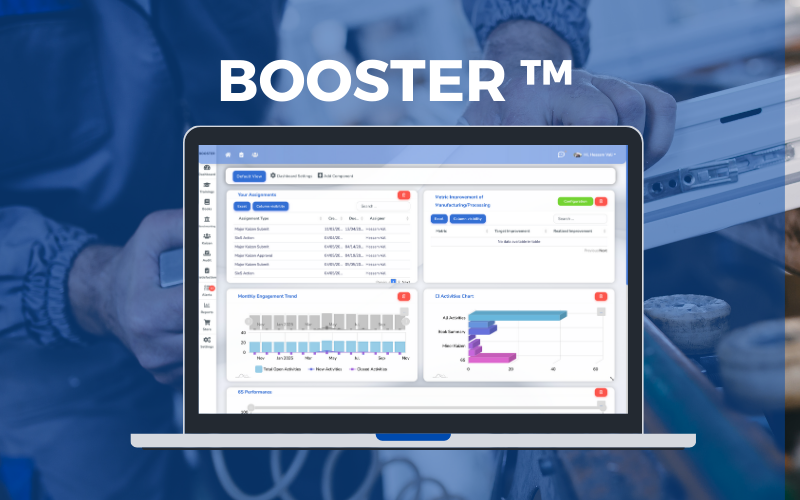
Booster is Optegrity’s operational excellence team development module — purpose-built to make lean capability visible, structured, and sustainable.
Improvement projects are tracked from initiation to close, with owners, milestones, and status visible in real time. Lean certifications are managed at the individual level, tied to current standards, and connected to the projects each team member is qualified to lead. Development plans are documented and trackable — so the investment your organization makes in its people actually shows up in performance.
The result is an operation where continuous improvement does not depend on any single person paying attention. It runs because the system supports it.
The Difference Between a Lean Event and a Lean Culture
A lean event produces improvement. A lean culture sustains it.
The manufacturers who pull ahead are not the ones who run the most kaizen events. They are the ones who build the internal capability to keep improving after every event ends — shift by shift, project by project, quarter by quarter.
Booster is how that capability gets built and kept.
Frequently Asked Questions
What is Booster and what does it do?
Booster is Optegrity’s OpEx team development module. It manages lean certifications, tracks improvement projects from initiation to close, and supports structured development of the internal capability needed to sustain a continuous improvement culture.
Why do lean programs lose momentum after the initial engagement?
Most lean programs are built around events such as kaizen blitzes, value stream mapping sessions, and training workshops. When the event ends, the structure that supported it disappears. Without a system to track projects, manage certifications, and develop team members deliberately, improvement depends on individual motivation rather than organizational infrastructure. That is why it fades.
How does Booster connect to the rest of the Optegrity platform?
Booster is designed to work alongside Routine (standard work), Gigbot (defect tracking), Resolve (problem-solving), and Gaugebot (maintenance and calibration). Together, they give operations leaders a connected system where improvement is not a department or a program; it is how the operation runs.
What does lean certification management look like inside Booster?
Certifications are tracked at the individual level, tied to each team member and the current standard, and automatically flagged when they are due for renewal. Leadership can see at a glance who is certified, who is in development, and who is ready to lead specific types of improvement work.
How is Booster different from a project management tool?
General project management tools are not designed for continuous improvement work. Booster is purpose-built for OpEx. It helps teams connect improvement projects to the team members running them, to the lean certifications that qualify them, and to the development plans that grow their capability over time. It is not just tracking projects. It is building the team that runs them.
Leave a Reply