
Lean Culture Doesn't Survive on Enthusiasm Alone.
Great events. Good intentions. And six months later, the gains are gone. Sustaining a culture of continuous improvement requires infrastructure — a system that reinforces the standard, tracks capability, and makes improvement a daily habit.
That is what Booster is built to do.
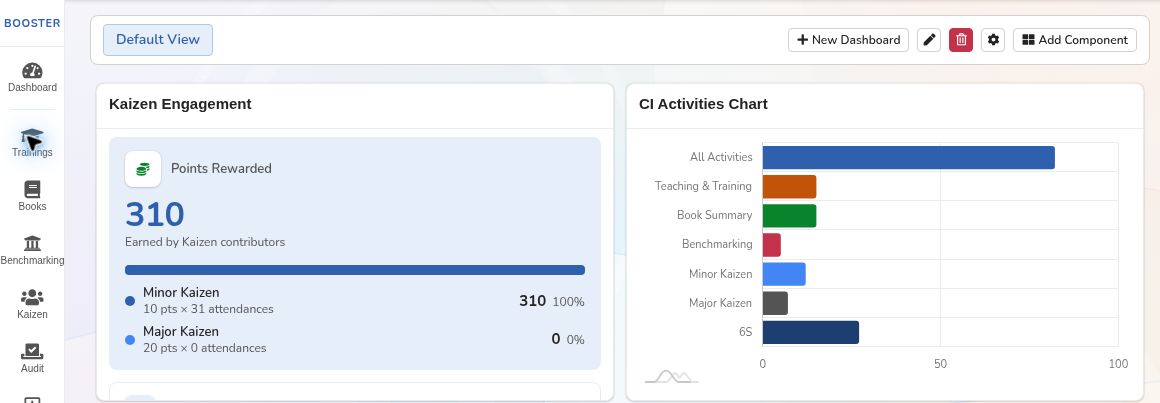
Most CI programs succeed at the event.They fail at the follow-through.
The kaizen was great. The team was energized. The whiteboard has 40 sticky notes. And then the operator who led it takes another job.
The results never get formally measured.
The next supervisor doesn’t know what changed or why.
And the improvement quietly erodes back to baseline.
This is not a motivation problem. It is a systems problem.
A lean culture needs the same thing a lean operation needs: a standard that is visible, tracked, and reinforced every shift.
Build It. Sustain It.
Booster™ — OpEx Team & Culture Development
Booster is the operational excellence program management tool behind every improvement that sticks.
Skills get tracked and certified — so when a key operator leaves, the knowledge doesn’t go with them.
Improvement programs are managed with A3 workflows and kaizen tracking — so your team knows what’s in progress, what’s complete, and what ROI it generated.
Gamified problem-solving engages frontline operators in identifying and solving problems — not just executing the standard, but improving it.
Financial impact reporting gives leadership the data they need to sustain the investment in people and process — not because it feels right, but because the numbers say it’s working.
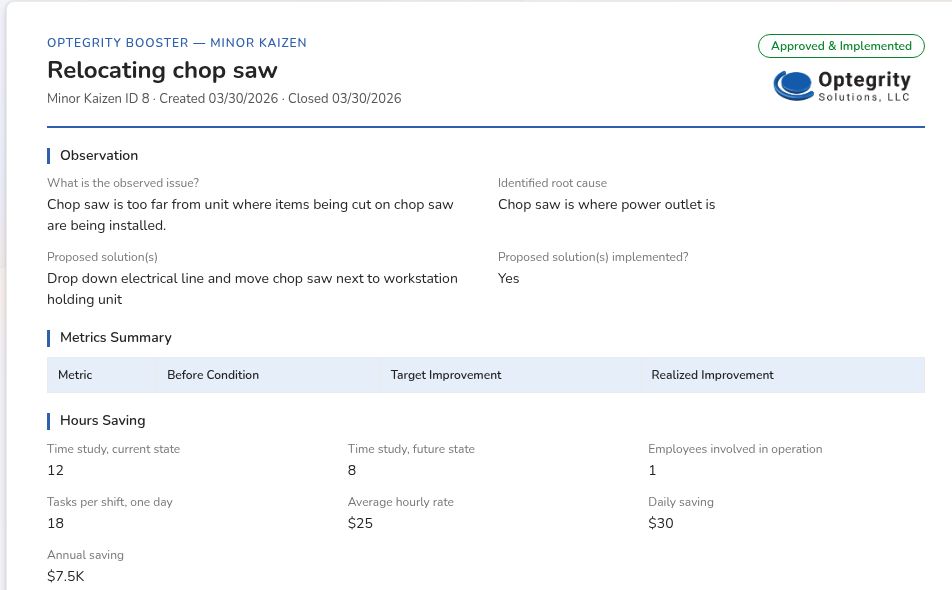
Example savings are demo inputs, not verified customer results.
Reward the Behavior You Want to Sustain
Continuous improvement cultures are built when the people closest to the problem are the ones solving it.
Booster’s recognition and engagement tools connect operator contributions to visible outcomes — so participation isn’t just expected, it’s rewarded.
Booster’s point system includes participation categories such as Minor Kaizen, Major Kaizen, audits, training, teaching, and benchmarking, with Bronze, Silver, and Gold level requirements. That gives teams a structure for recognizing a range of contributions.
Gamification gives everyday improvement a visible feedback loop. Recognizing a contribution, sharing progress, and seeing peers participate can help keep people involved after the launch event is over.
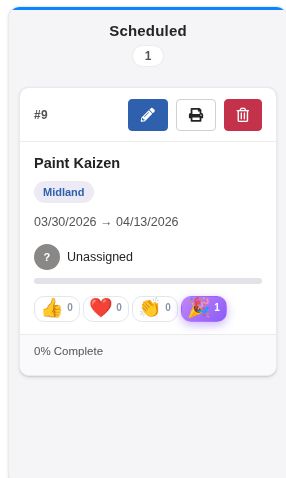
Use points and card reactions such as Like, Love, Clap, and Celebrate to acknowledge the behaviors behind improvement: raising a problem, contributing an idea, and helping the team learn. Pair that recognition with a review of what changed and whether it helped. Participation matters; so does the quality of the improvement.
For OEMs: Demonstrate supplier development capability and a measurable culture of quality.
For manufacturers supplying OEMs: Show your customers that your improvement is systematic, not reactive.

Training That Follows the Standard
A training matrix connected to your actual SOPs
When Routine updates a work instruction, the training requirement updates too. New operators are trained to the current version. Competency is documented. And when an auditor asks who was trained on what and when, the record is already there.
Culture is not a poster on the wall. It is the system your team works inside every day.
Keep the momentum after the Kaizen event.
A sustaining culture needs participation, follow-through, and a reason to come back.
Make it easy to contribute.
Give everyday ideas a place alongside larger improvement projects. A minor Kaizen can make a local problem visible; a major Kaizen or A3 provides a place for more structured improvement work.
When people can see their contributions, improvement becomes part of the working week rather than a separate campaign.
Make progress a team conversation.
Use improvement records in regular team reviews. Discuss what is moving, what needs support, and what the team has learned. Visible work creates an opportunity for coaching and follow-through.
Keep recognition close to the work. A reaction can acknowledge an idea; a conversation helps turn that attention into the next practical step.
Recognize the habit, then review the result.
Points and visible participation give teams ways to celebrate contribution and encourage friendly competition. They work best alongside a clear purpose: making the work safer, simpler, more reliable, or less wasteful.
Review results as well as activity. Use the recorded improvement and its impact to explain why the effort matters, rather than treating a points total as proof of success.
Bring the learning back to the standard.
When an improvement is ready to become the new way of working, review the relevant work instruction and training needs. Connect the learning to the routine your team follows.
Bring audit routines into that rhythm, too. Booster’s audit register makes area scores, due dates, and action or approval status visible, helping teams review whether the standard is being sustained.
That is how a successful event can become a repeatable practice: contribute, review, recognize, and reinforce.
Everyday ideas. Structured problem-solving.
Actual screens from the Optegrity trial environment, using demo data.
Make both small improvements and larger problem-solving efforts visible. Minor and Major Kaizen cards show contributions and reactions. Within Major Kaizen, the workbook brings the problem statement, current and target conditions, root cause, countermeasures, implementation, and follow-up into a structured workflow with an A3 Format view.
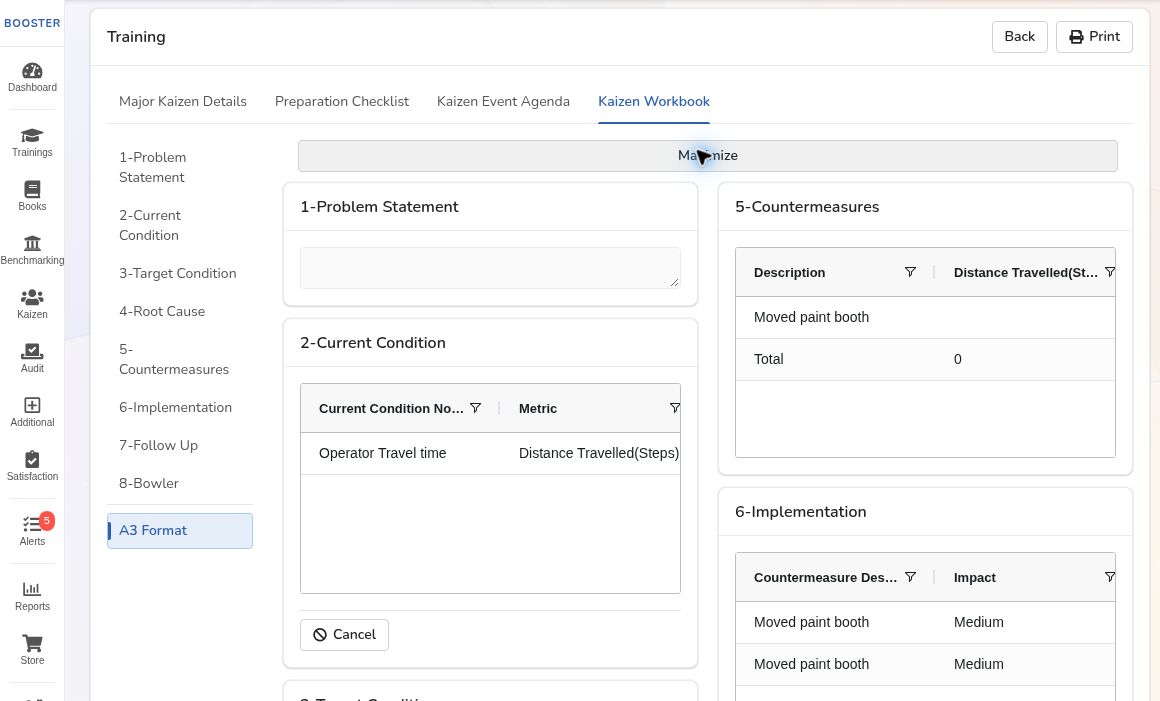
Minor Kaizen: recognize everyday improvements.
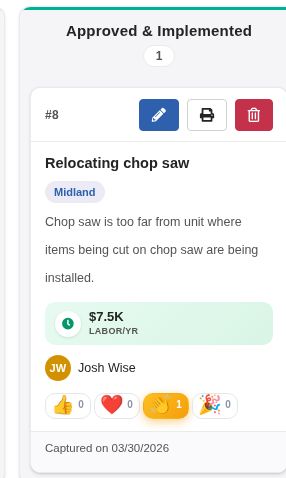
Major Kaizen: keep larger efforts visible.
Savings and progress shown are demo values, not verified customer outcomes.